

Dear Face™: What Are You Ready to Let Go Of?
Dear Face,
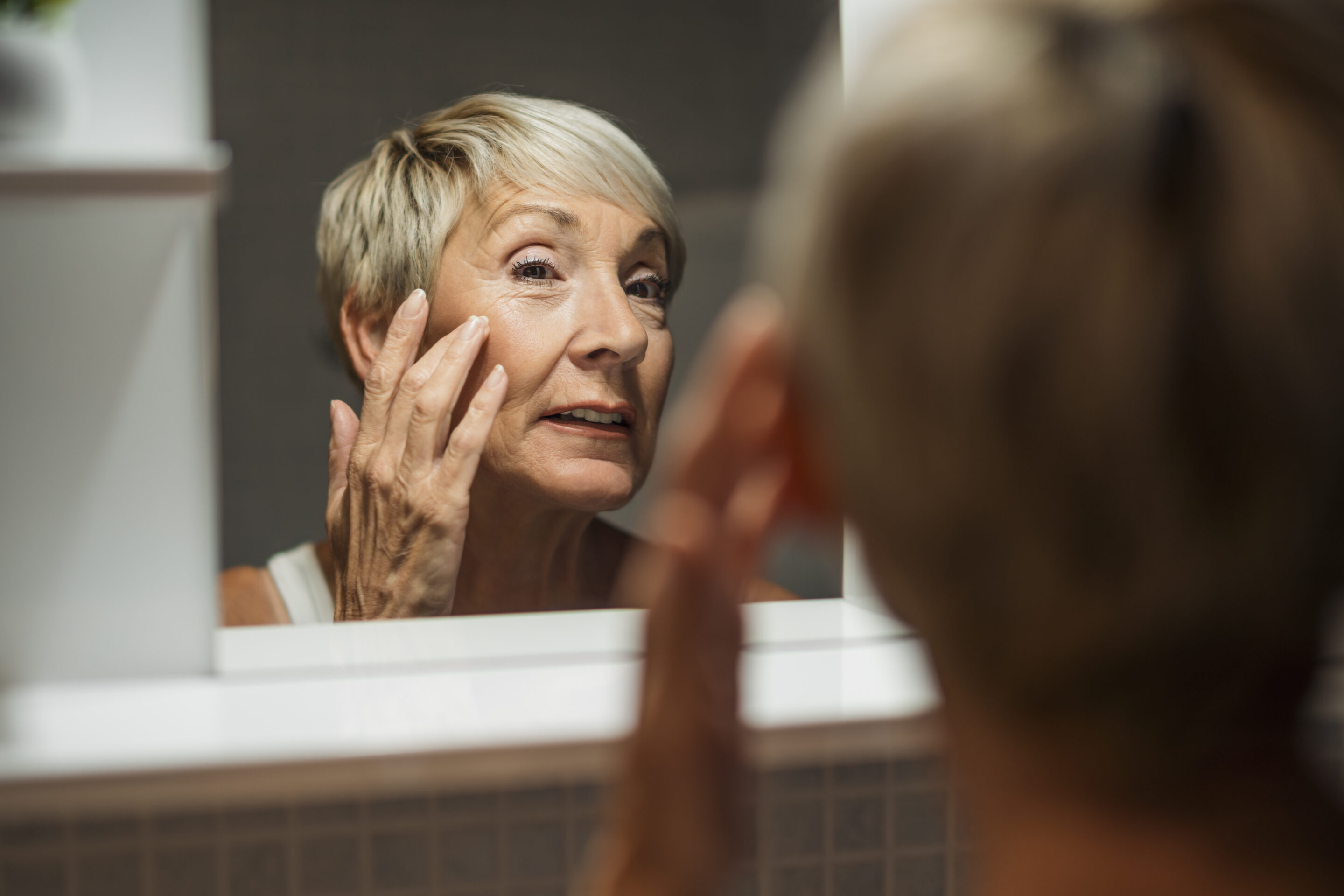
As we move into fall, I want to take this opportunity to shift something—not your routine, not your products, and not even your face, at least not directly. What I want to shift is how you interpret what you see when you look in the mirror, because that interpretation quietly shapes everything that follows.
Most people don’t realize how quickly the mirror becomes a place of evaluation instead of connection. You look, and almost immediately, your attention shifts to assessment. You begin to scan for change, trying to determine whether what you see is better, worse, or simply unfamiliar. Without consciously choosing it, your mind organizes those observations into a conclusion that feels both subtle and definitive: something is changing, and that change must mean you are aging.
The difficulty is not aging itself. The difficulty is how much meaning has been layered onto that word and how quickly visible change becomes interpreted as loss. Loss of tone, loss of structure, loss of something that once felt more aligned with how you see yourself. When that interpretation becomes automatic, the face is no longer experienced as something that belongs to you. It becomes something you begin, often quietly, to manage.
What I want you to consider instead is that what you are seeing may not be aging in the way you have been taught to think about it. It may be an accumulation.
The face is not passive. It is responsive, adaptive, and highly organized. Over time, it reflects what has been repeated, not just in expression, but in how the body has held itself through different periods of life. Every moment of sustained focus, every instance of tension that was maintained instead of released, every time the body stayed in a particular state longer than it was designed to—all of that leaves an imprint. Not as damage, but as a pattern.
This becomes structural because of how the face is built. The muscles of expression are not separate from the skin in the way muscles are in other parts of the body. They are interwoven within a fascial network that both allows movement and stabilizes it. When a pattern is repeated long enough, that network begins to organize around it. The muscles do not simply contract and release; they begin to favor certain positions, and the surrounding tissue accommodates that preference.
Over time, what began as a response becomes a baseline.
This is why what you see in the mirror often feels more complex than the idea of aging alone. What is visible is not simply the passage of time but the visible record of how long certain patterns have been held in place. It reflects how long the body has remained in particular positions of focus, responsibility, restraint, or endurance without fully returning to neutral.
That reflection is often recognizable, even if it has never been named. You may notice a persistent contraction through the brow that once served concentration or concern but now remains even in moments of rest. You may feel a subtle holding through the jaw that is no longer tied to anything specific, yet has not released. Around the eyes, there can be a quality of alertness that lingers long after the circumstances that required it have passed.
These are not isolated emotional expressions. They are organized patterns within the tissue.
From a clinical perspective, these patterns are not random, and they do not dissipate simply because the conditions that created them have changed. When a position is held repeatedly, the tissue adapts in a way that makes that position easier to return to. The fascia accommodates it, the muscles remain slightly engaged, and the face begins to organize around that pattern as a point of efficiency. Over time, that efficiency becomes structure, and structure, by its nature, does not shift without a new input.
This is where integrating the experience becomes a bit of a challenge for many people, because there can be a genuine sense of internal change without a corresponding shift in the face. You may feel more at ease, more grounded, or more aligned than you did years ago, yet your reflection still carries the imprint of a time when you were holding more than you are now. Without realizing it, you begin relating to that reflection as if it represents your current state, rather than recognizing it as a record of what has been maintained.
That is where the disconnect begins.
The face is not just expressive. It is diagnostic in the sense that it reflects what has been consistently held within the system. Patterns that remain in the tissue continue to communicate through the nervous system, reinforcing the same internal signals that created them. In this way, the body can continue to organize around a pattern long after it is no longer required, not because it is stuck, but because it has not yet been given a reason to reorganize.
This is why the idea of letting go becomes relevant in a very specific way.
If fall represents anything, it is not simply change, but a natural release of what no longer needs to be maintained. In the context of the face, that does not mean doing nothing, and it does not mean forcing change. It means recognizing where patterns are still being unconsciously reinforced and creating the conditions for them to soften.
The goal is not to erase what your face has been through. It is to allow it to stop holding onto it.
There are moments in life when the body is asked to hold more—more responsibility, more uncertainty, more emotional weight than it would naturally choose. During those times, the face will organize around that demand in real time. The patterns we’ve been talking about are not only something that developed years ago. They are forming now, in response to what is currently being lived.
This is why releasing isn’t something reserved for after a season has passed.
The ability to soften while you are in the experience—not after it—is what changes how the pattern is formed in the first place. It allows the body to move through a state rather than organizing around it.
Even small moments of release matter. A shift in how the jaw is held, a softening through the brow, a return to movement in the face instead of maintaining a fixed expression—these are not minor adjustments. They are interruptions to a pattern that would otherwise become structural.
In that sense, letting go is not a single act. It is something that can happen in real time, as life is being lived.
This is where the conversation around aging gracefully requires a more nuanced understanding. It is not a matter of disengaging or ignoring what you see, nor is it about aggressively trying to erase our muscles and correct every visible change. It is about staying in a relationship with your face in a way that supports its ability to adapt, rather than locking it into patterns that no longer reflect who you are.

Caring about your face is not the issue. In many ways, it is a reflection of how you care for your overall health and vitality. The distinction lies in how that care is expressed. When care becomes control, the system tends to tighten. When care becomes support, the system has the opportunity to respond.
For me, the intention has never been to look younger. It has been to maintain a sense of timelessness—where my face continues to reflect who I am now, rather than holding onto who I had to be in the past.
Timelessness, in that sense, is not about appearance. It’s about responsiveness and resilience.
It requires maintaining movement, circulation, and variability within the tissue so the face does not become fixed in one version of expression. When the face can still shift, still soften, still respond to the present moment, it no longer feels like it belongs to a specific point in time.
It feels current.
It feels aligned.
It feels like you.
That kind of responsiveness does not occur passively. Patterns that have become structural do not shift through intention alone, and they do not reorganize through surface-level intervention. The tissue itself has to experience something different. It has to be engaged in a way that reintroduces movement, supports circulation, and allows the system to reorganize out of what it has been maintaining.
This is the space I have spent decades working in, because it sits between what people feel and what they see. It is also what led me to develop the Tru Energy® Facelift System and the Energy Optimized® Wand—not as a means of correction, but as a way to work with the tissue directly, supporting the release of long-held patterns so the face can begin to respond differently.
Ultimately, the method matters less than the principle.
The face needs the opportunity to let go.
Not abruptly, and not through force, but through consistent support that allows the tissue to soften, move, and reorganize over time. When that begins to happen, the change is not dramatic in the way people often expect. It is subtle, but it is unmistakable. The face appears more open, more at ease, and more aligned with how you feel, as the brain is no longer being signaled to hold what is no longer there.
So as you move into this season, instead of asking what you need to add, it may be more useful to consider what you are ready to stop holding.
Because your face has been paying attention to everything you have carried.
And it is always capable of responding when it is given the opportunity to do so.
Face Notes: Supporting Release as the Season Shifts
As the season changes, the skin and underlying tissue are already in a process of adjustment, which makes this an ideal time to support release rather than add additional layers of stimulation.
A consistent, gentle exfoliation helps clear accumulated surface cells that can interfere with how the skin receives hydration and nutrients, allowing the tissue to respond more effectively. At the same time, maintaining barrier integrity becomes increasingly important as the environment shifts, since well-supported skin remains more adaptable and less prone to holding tension.
Equally important is the reintroduction of intentional movement. Even a few minutes of engaging the tissue—whether through your hands or with a tool—can begin to interrupt patterns that have become fixed, creating space for the face to respond differently.
If you want to take this a step further, you can begin by simply seeing your face more clearly. I’ve created a way to take a photo and receive personalized insight into the patterns your face may be holding, along with guided steps to support release and responsiveness.
You can access that here: TruEnergySkincare.com/BHL10.

This is part of the same philosophy behind the Tru Energy® system, including the cleanser, exfoliation support, and the Facelift System with wand. Each step is designed to support movement, circulation, and responsiveness within the tissue, particularly during seasonal transitions when the system is more receptive.
Keep the approach simple and consistent. Support what the skin and underlying structure are already attempting to do, and allow that support to be sufficient. For deeper support: TruEnergySkincare.com/BHL10.
To Your True Self,
—Cathy Goldstein, AP
Dear FaceSM is a monthly column by Cathy Goldstein, AP, an acupuncture physician with over four decades of clinical and academic experience in holistic health. Her work views beauty as an expression of balance, vitality, and biological communication, exploring how restoring function supports a naturally resilient, expressive face.
Have a Question for Dear Face™?
Each column begins with a real question because communication is always happening. We’re just learning how to listen.
Dear Face™ is a monthly column by Cathy Goldstein, AP, an acupuncture physician with 40 years of clinical practice.
Her work approaches ageless beauty as a reflection of expression, vitality, and biological communication, supporting a look that feels as alive as it appears. It’s an expression of balance, vitality, and biological communication, exploring how restoring function supports a naturally resilient, expressive face.
“Beauty isn’t something we correct; it’s something we restore. “Dear Face™ is a monthly reflection on the emotional, energetic, and physical language of the face.”
— Cathy Goldstein, AP
- Connect with Cathy Goldstein
- More articles from our columnist, Cathy Goldstein
