

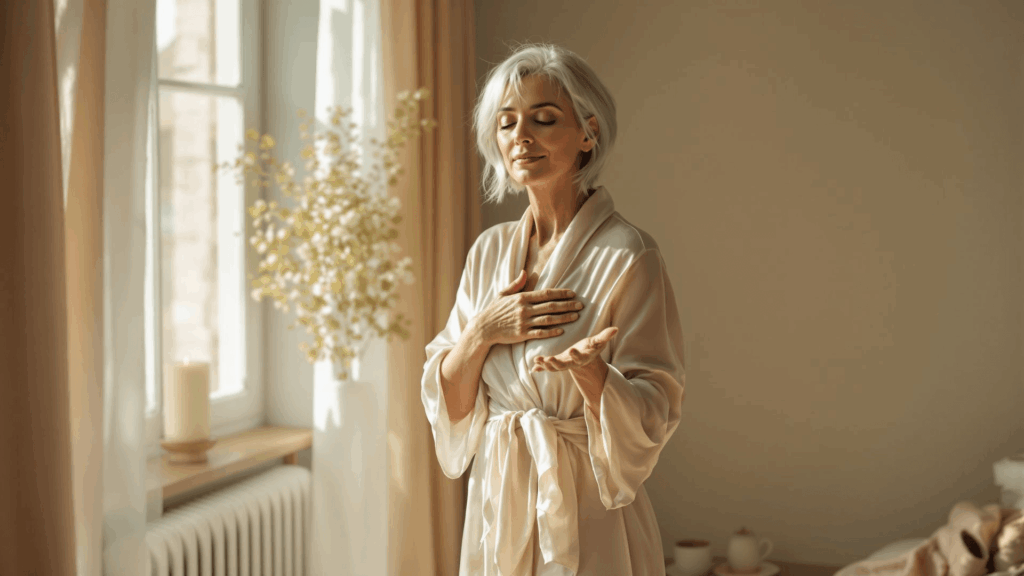
My Body, My Ally: The Wise, Sensual Partner—The Most Essential Love Affair
February is the month of love. While the world is busy celebrating romance, I like to think of it as the month to rekindle your most essential relationship: the one you have with your own body.
Many of us have spent years at war with our bodies—criticizing, comparing, and trying to control. We chase “better” numbers on a scale or steps on a tracker, hoping that will bring us peace. Yet true love never begins with criticism. What if, instead of treating our bodies like problems to be fixed, we began to treat them as allies—wise, sensual partners that hold the key to our vitality, healing, and joy?
Love, Loss, and Disconnect
I was so lucky to meet my late husband, Michael, when I was 51 years old. His love created a safe space for me to connect positively with my body, even through its midlife changes.
When he died in 2024, I experienced what many grieving people do: a huge disconnect from my body. I felt my grief in my body—tightness in my chest, a lump in my throat, and profound mental and physical fatigue. I stopped caring about what I ate or how I moved. My appetite came and went. My energy vanished.
The Body’s Surprising Reawakening
And then, after months of grief recovery and inner work, something unexpected happened. I began to feel sparks of life returning—not just emotional life, but physical, sensual aliveness. I once wrote about this phenomenon as “widow’s fire”—the body’s surprising, almost defiant, resurgence of desire after loss. It’s the body’s way of saying, “You are still here. You’re still alive.”
That awakening was both exhilarating and terrifying. I wanted to feel beautiful again, to move, to touch, to be touched. Yet I also felt afraid—afraid of judgment, of being misunderstood, of what people might think about a widow daring to feel desire again. But here’s what I’ve learned: our bodies are wiser than our fears. They are not bound by social scripts. They simply seek life in every sense.
From Fixing to Partnering with My Body
As I began to listen more closely, I realized how much my body had to teach me—not just about sensuality, but about my overall health.
Grief had changed my relationship with food, sleep, and movement. I wanted to feel lighter, stronger, and more alive in my skin. Yet the old narratives about “fixing” my body didn’t fit anymore.
I didn’t want to punish my body back into shape. I wanted to partner with it—to find balance between acceptance and improvement. First were gentle Zumba classes, then longer walks, then bigger gym workouts. It was bittersweet to get back to dancing tango, the dance Michael and I enjoyed so much together.
We often treat body acceptance and health as if they are opposites: either you love yourself exactly as you are and never change, or you push yourself to change because you’re unhappy. Both extremes miss the truth.
- You can love your body deeply and want to help it feel better.
- You can cherish your curves and crave strength and energy.
- You can accept yourself today and work toward more vibrant health tomorrow.
Self-acceptance and self-improvement are not enemies. In fact, acceptance is the soil in which healthy change can grow.
Listening to the Body’s Wisdom
In my own journey, this has meant letting go of rigid goals and instead tuning into my body’s messages.
Some days it asks for movement—a long walk, a stretch, a dance that reconnects me with joy. Other days, it pleads for rest or nourishment. When I listen and respond with kindness, my body rewards me with vitality and calm.

The Healing Power of Sensuality
Sensuality has also become part of that healing. Sensuality isn’t only about sexuality—it’s about being in your senses. Feeling sunlight on your skin. Tasting something delicious. Breathing deeply enough to feel your ribs and belly expand. It’s about presence—and presence is where both pleasure and healing live.
Through that awareness, I realized my sensuality wasn’t something that belonged only to my past life with my husband. It was—and is—part of who I am. It connects me to life itself.
Dating, Desire, and Defying Expectations
Dating again has been fun. Laughter and companionship don’t diminish what I’ve lost; they honor the part of me that still loves life.
I used to think sensuality was about someone else—how they saw me, touched me, and wanted me. Now I’m realizing it starts with me: how I feel, how I move, and how I enjoy this moment. This is a huge transformation. I’ll share more about it soon.
Let’s just say… I’ve been doing “field research” on what it’s like to date in midlife. Results so far: fascinating, unpredictable, and mostly very fun. Stay tuned.
Still, I’ve wrestled with fear of judgment—for dating again, for wanting to feel attractive, for embracing both grief and desire. We live in a culture that can be quick to label women’s bodies and choices. But I’ve come to see that caring for myself—whether it’s nourishing food, movement, or intimacy—isn’t about performing for others. These are acts of self-love.
A New Kind of Love Resolution
When I choose to eat foods that energize me, move in ways that bring joy, or rest when I need it, I’m not rejecting myself—I’m honoring the woman I’ve become. My goal isn’t perfection; it’s progress in partnership with my body.
This February, I invite you to make a new kind of love resolution—one that doesn’t involve chocolates or champagne (although those are lovely too).
Every day, offer your body one small act of love. A deep breath. A stretch. A nourishing meal. A dance in your kitchen. A kind word to yourself in the mirror.
Notice how your body responds when you treat it as an ally rather than an adversary. This body has carried you through joy, grief, and every single moment of your precious life. It deserves your tenderness, curiosity, and care.
Walking Hand in Hand with Your Body Your body is not your enemy or your project to fix. It’s the vessel for your soul. This February, fall back in love with it. Walk hand in hand with your body—wise, sensual, resilient—into your full, radiant life that lies ahead.

“After loss, my body reminded me that life—and even desire—still lives inside me. It became my teacher, my compass, and my partner.” – Dr. Liz Lyster
- Connect with Dr. Liz Lyster
- More articles from our Executive Contributor, Dr. Liz Lyster