


Swimming: The Lifesaving Skill that lasts a Lifetime. Summer can be a great time. Children are on break from school, so most families vacation during the summer. To beat the heat, millions flock to beaches, lakes, rivers, and pools. Some of my earliest and happiest memories are those of my family spending time together at the beach.
Bodies of water have a profound effect upon the human psyche. The mesmerizing quality of water seems to beckon us. Swimming pools, in particular, have an alluring beauty, enhanced by light reflecting off their glistening, seemingly serene surface. The tantalizing appeal of a pool is especially enticing to a young child, which all too often results in tragedy. That is why every child must know how to swim.
With proper training, children, even toddlers, can learn to swim. My father, Earl, was a uniquely qualified swimming instructor, having been a US Navy SEAL and expert scuba diver. After he married my mother, Jeannie, they lived in north New Jersey just outside New York City. They soon had two children, my older sister and brother. My parents were active in the local YMCA where dad taught swimming lesson for scores of children including my siblings.
Dad’s teaching method started with the dog paddle, where you lie on your chest, keep your head above water while methodically paddling with your arms and kicking with your feet. Dog paddling is a natural human skill everyone possesses—but one which can immediately vanish if you panic. That is why Dad’s teaching method gradually introduced children to the water so they became comfortable and didn’t panic. This progressed to more advanced swimming and breathing techniques. Dad made swimming fun, but he always taught that everyone must respect the water because it could be dangerous. He taught his toddler pupils that even if you can swim, you must never go into the water without adult supervision.
But then I was born, and when I was eighteen-months-old my dad got a job with an aerospace contractor in Orlando, Florida. Leaving New Jersey behind, we moved to Florida. For dad Florida was a land of new business opportunities. Mom, on the other hand, felt like she’d landed on a strange alien world.
Mom was a city girl who went from living twenty minutes from the sights, sounds, shopping, and excitement of Manhattan to the outskirts of Orlando. Mom had worked in the fashion industry and loved the change of seasons, which required a seasonal change of wardrobe. Florida, on the other hand, was constantly hot, humid, and swarming with mosquitoes. For mom, Florida seemed to have only two seasons—summer and hell.
As if that wasn’t enough, we’d moved into a housing development adjacent to dense jungle-like swampy wetlands. Everywhere around our house, there were ditches, canals, and ponds.
This greatly concerned my parents because I was a toddler with a penchant for water who was constantly trying to slip away to play in any body of water I could find. Therefore, my parents decided that I must learn to swim. Unfortunately, Dad’s new job required long hours and frequent business trips, meaning he didn’t have the free time required to teach me how to swim.
A few months before I was two-years-old, my parents enrolled me in swimming lessons at the local YMCA. I remember the teacher all too well. She had what I now describe as a northern European accent. She was thin, didn’t smile much, and had a firm, imposing demeanor.
The kids’ mothers were not permitted to observe the swimming lessons. The official reason was that children would be distracted by focusing on their moms instead of paying attention to the swimming teacher.
My mom, however, slipped back in to see my first swimming lesson—and it wasn’t what she expected. The swimming teacher held me in her arms and took me with her into the pool. Then she let me go and said, “swim or drown.”
Terrified, I plunged underwater—but then my instinctive, natural dog paddling skills kicked in. I paddled for my life, hands moving swiftly and feet kicking hard. As I broke the surface, my instructor lifted me up and asked, “Did you see ze big fishy?”
Almost drowning was frightening enough, but then the thought of a child eating a sea monster lurking somewhere in the depths of the pool didn’t exactly calm my anxiety.
Horrified, my mother called out and demanded I be released. The swimming instructor kindly requested my mother not interfere with “ze process,” as a lifeguard politely escorted mom out of the pool area.
This instructor’s methodology differed radically from my father’s gentle “swimming is fun” approach. I’ve often wondered if this macabre method of throwing a toddler in the pool and saying “swim or drown” had its origins in some grotesque Viking human sacrificial rite. The only thing missing was Wagner playing in the background. And for all I know, it was.
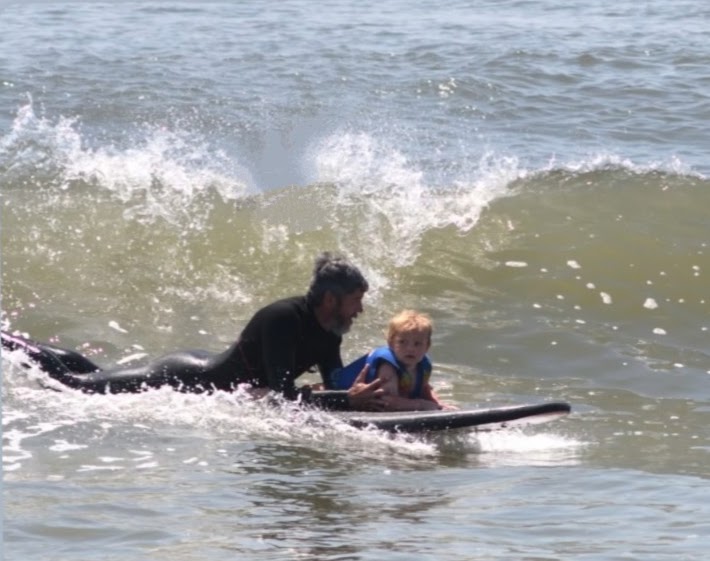
But at any rate, I learned how to swim. After all, my toddler self had limited options; it was either swim or drown.
Since then, the approach to swimming lessons has changed, but the importance of teaching young children to swim has not. The National Safe Kids Campaign has stated that after car accidents, drowning is the second leading cause of unintentional deaths for children.
Swim England encourages parents to enroll children in swimming lessons because “you can’t always be there.” Sadly, I know this to be true. During my tenure as an attorney, I encountered many childhood drowning cases. Drowning happens fast. In the blink of an eye, a child can fall into a body of water, often a pool. In most instances, this happens when one parent thinks the other parent is watching the child. There are no words capable of describing this horrific tragedy.
According to Waterworks Aquatics Swim School, drowning is extremely preventable, which is why it is essential that all children learn to swim at a young age. In addition to Waterworks Aquatics programs, swimming lessons are readily available through private, commercial, and community organizations like the Red Cross and YMCA.
Teaching children to swim has many benefits. A 2009 study at the University of Canberra in Australia found that children under the age of five who participated in swimming lessons developed a wider range of skills earlier in their development than their peers who were not taught to swim. Children who took swimming lessons had improved balance and coordination, advanced social and cognitive development, and a better understanding of directions, which prepares them to respond effectively to teachers in the classroom. Kids who learned to swim also exhibit greater comfort in interacting with peers and adults.
When my father retired, he had plenty of time to teach his grandchildren to swim when they were toddlers. Dad also taught them that even though you know how to swim, never ever go in the water, be it a pool, lake, or the ocean, without adult supervision.
My parents left us with a legacy of wisdom, and one of their most important lessons is that good parents teach their children to swim. While my parents have left this world for eternity, their grandchildren have continued the family tradition of teaching their young children to swim, respect, and enjoy the water.
Swimming is a skill like riding a bicycle; once you learn how to do it, you can enjoy it for your entire life. And swimming is the only sport you can teach your child which can save your child’s life.
“Swimming is the only sport you can teach your child which can save your child’s life.”
-Mark Anthony, JD, Psychic Explorer®

FREE OFFER: Mark Anthony conducts free on-air readings on his livestream show THE PSYCHIC & THE DOC on Thursdays at 7 pm ET/4 pm PT. Find out how to tune in and join us.
- To schedule a reading with Mark, visit his website
- More articles from our VIP Executive Contributor, Mark Anthony.
