

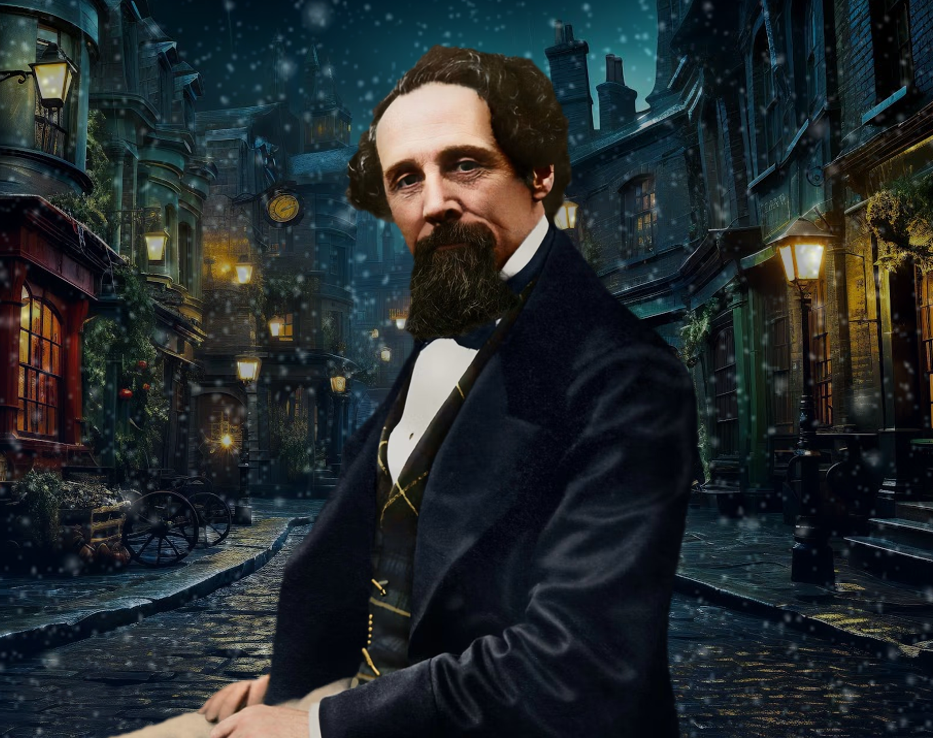
Is There A Ghostly Truth Behind “A Christmas Carol”? – During December, it’s hard to ignore the holidays. Do you delight in family and friend reunions, gift giving, charitable donations, cheerful music, tasty treats, colorful lights, and decorations—or are you a Scrooge? We all know the mean-spirited holiday hater Ebenezer Scrooge from Charles Dickens’ “A Christmas Carol.”
After the scriptural account of the birth of Jesus, “A Christmas Carol” is arguably the most famous holiday story. First published in December 1843, “A Christmas Carol” sold 6,000 copies within a week! Even today, those sales would catapult a book onto the New York Times Bestseller List. As a Christmas tradition, every generation since has had its version of it, from stage to screen. There have been over 100 film and TV versions. Critics hail the 1951 “Scrooge” as the film most faithful to the Dickens classic. Personally, I prefer the 1992 version starring the Muppets.
“A Christmas Carol,” set in Victorian London, is about miserly and miserable Ebenezer Scrooge, who loves only money, despises poor people, and loathes everything Christmas. He encounters the spirit of his deceased business partner, Jacob Marley, who warns him to change his ways. Next, Scrooge is visited by the Ghosts of Christmas Past, Present, and Future, which causes him to transform overnight from naughty to nice.
We all know the story—or do we?

Beyond the holiday theme and good triumphs over evil moral, “A Christmas Carol” may be based on a mysterious ancient phenomenon. For thousands of years there have been documented accounts of people who died and lived to tell the tale. These “resurrections” baffled physicians and religious leaders alike. We now know this phenomenon as a Near-Death Experience (NDE), which occurs when someone dies and that person’s soul/consciousness separates from the body, remains intact, but then the person returns to life.
Most NDE accounts describe a sensation of leaving the body, traveling through a tunnel into a brilliant light and encountering deceased loved ones and other spiritual beings. A major component of an NDE is the life review, which is a vivid recall of one’s entire life and the impact that person had on others.
While the vast majority of NDEs are pleasant, uplifting, and euphoric, some people experience a “Distressing Near-Death Experience” (DNDE), more commonly known as the “Hellish NDE.” While these are the least common type of NDEs, they’re extremely profound. My colleagues and fellow NDE researchers, Dr. Bruce Greyson, Dr. Ken Ring, and Nancy Evans Bush, agree with me that a Hellish NDE is a cosmic wake-up call to change course in life, make amends, and become a better person.
Is “A Christmas Carol” based on the Hellish NDE? Even though the term NDE didn’t yet exist, these mysterious resurrections were well known and studied in Victorian paranormal circles. This was also the “age of spiritualism,” which popularized mediumship—the ability of people to communicate with spirits. Dickens studied psychic phenomena and the occult. Although he approached supernatural phenomena with skepticism, Dickens was a member of London’s “Ghost Club” and even participated in paranormal investigations.
The case for whether “A Christmas Carol” is based on the Hellish NDE strengthens when elements of NDEs are compared to the sequence of events in “A Christmas Carol.”
THE NEAR-DEATH EXPERIENCER: Ebenezer Scrooge is a miserly, self-centered money lender and debt collector who co-founded a financial firm with his late business partner, the equally selfish Jacob Marley. Since Marley’s death, Scrooge has become a bitter old man. His sole employee is warm-hearted Bob Cratchit, who symbolizes Victorian London’s working-class poor. Cratchit is happily married with six children, the youngest of whom is the physically disabled yet ever cheerful Tiny Tim.
When Cratchit asks for Christmas Day off, Scrooge replies, “Bah, Humbug!” Begrudgingly, Scrooge agrees, but complains Christmas is an excuse for paying a day’s wages for no work.
Next, two gentlemen ask Scrooge for a charitable donation to help poor people. Refusing, Scrooge sneers, “Are there no prisons? Are there no workhouses?” One of the gentlemen explains many poor people would rather die than go to such places. Scrooge callously replies, “If they would rather die, they had better do it and decrease the surplus population.”
NDE TRIGGER AND SPIRITUAL ENCOUNTERS: Dying or a severe life-threatening condition triggers an NDE, which can lead to encountering spirits of deceased loved ones and other spiritual beings. Due to unsanitary conditions, food poisoning and cholera were widespread in Victorian London. Scrooge spends Christmas Eve alone in his large, gloomy house, which may be analogized as the threshold between life and death, where Scrooge encounters the spirit of his business partner, Jacob Marley.
Shackled in chains of cashboxes and ledgers as punishment for a lifetime of greed, Ghostly Marley warns Scrooge he can avoid this hellish fate by heeding the three spirits who will soon visit. There’s evidence for food poisoning in Scrooge’s cynical response to Marley’s spirit, “You may be an undigested bit of beef… There’s more gravy than grave about you, whatever you are!”
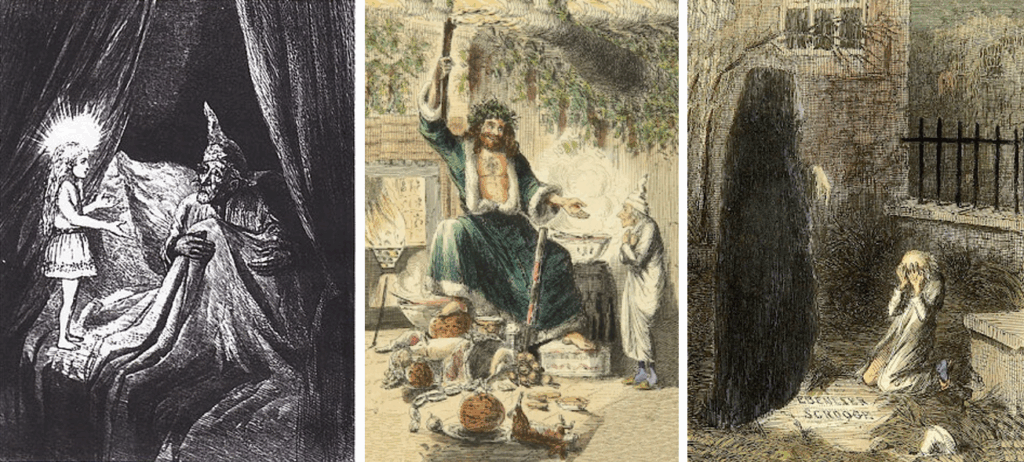
THE LIFE REVIEW: The Ghost of Christmas Past, who emits light from its head and shifts in appearance from child to old man, transports Scrooge back in time to a Christmas dance when he was young and with his girlfriend, Belle. Scrooge agonizes, reliving the heartbreak of Belle leaving him because he loved money more than her. The spirit’s parting words, “I told you these were shadows of the things that have been; they are what they are, do not blame me.”
VERIDICAL PERCEPTION: During NDEs, the soul is separated from the body and able to accurately perceive events in different locations which are occurring in real time. The Santa-like Ghost of Christmas Present takes Scrooge to observe Bob Cratchit and his loving family enjoying a simple Christmas dinner. He’s moved by the fragile Tiny Tim. Next, Scrooge is whisked to a joyful Christmas celebration at the home of the nephew he’s rejected. The spirit then reveals two homeless children hiding under the spirit’s robes. When Scrooge expresses concern for them, the spirit haunts Scrooge with his own words, “Are there no prisons? Are there no workhouses?”

PERCEPTION OF FUTURE EVENTS: The Ghost of Christmas Future, reminiscent of the Grim Reaper, reveals to Scrooge how his possessions will be stolen by unpaid servants who hate him. Scrooge is devastated seeing the Cratchits mourn Tiny Tim, who died because his family couldn’t afford better living conditions and medical care. Scrooge is haunted by his callous words about how the poor should die and “decrease the surplus population.”
Finally, Scrooge comes to a graveyard. A desolate tombstone reads: EBENEZER SCROOGE.
TIMELESSNESS: NDEs include a sense of timelessness, which contradicts our perception of time. Scrooge returns believing he’s been gone three days but discovers it’s Christmas morning—everything he experienced occurred in just one night.
TRANSFORMATIVE: NDEs, particularly Hellish NDEs, are life-changing. Scrooge embraces the Christmas spirit, becomes selfless, generous, and compassionate, makes amends with his nephew, and hikes Bob Cratchit’s salary, thereby saving Tiny Tim’s life.
The spiritually transformative effects of an NDE can take years to fully understand. Two centuries later, “A Christmas Carol” continues to entertain, mystify, and inspire us. If Dickens didn’t base “A Christmas Carol” on Near-Death Experiences, it certainly is one heck of a synchronicity.
The best gift is one which keeps on giving. On behalf of my fellow authors, special thanks to our Editor-in-Chief, Jana Short, for giving us a very special gift—the honor of writing for Best Holistic Life Magazine. Our greatest gift is the readers—thank you for your love and support.
And in the words of Tiny Tim, “God Bless us, everyone!”
“We all know the story A CHRISTMAS CAROL—Or do we?” – Mark Anthony

FREE OFFER: Mark Anthony conducts free on-air readings on his livestream show THE PSYCHIC & THE DOC on Thursdays at 7 pm ET/4 pm PT. Find out how to tune in and join us.
- To schedule a reading with Mark, visit his website
- More articles from our VIP Executive Contributor, Mark Anthony.